In 2024, the town will commemorate the 175th anniversary of Yarmouth’s incorporation in 1849, when Yarmouth as we know it today split off from North Yarmouth to become an independent town. Incorporated in 1680, the earlier town of “Ancient” North Yarmouth encompassed quite a large area around Casco Bay and parts further inland and included the modern-day towns of Yarmouth, North Yarmouth, Cumberland, Freeport, Pownal, and parts of Brunswick and Harpswell.
Over time, most of these towns were set off, leaving only Yarmouth and North Yarmouth remaining as the core of the original town in 1821. The town’s long and narrow shape at this time made town administration difficult as residents further inland were often quite far from the primary civic, social, educational, and religious institutions that were located closer to the coast. Additionally, there was a growing divide between the primarily agricultural occupations of the inland areas and the maritime, manufacturing, and mercantile interests of coast and village residents. Historian William H. Rowe records that discussions about secession on both inland and coastal sides had started to occur in the 1820s. By 1848, the secession debate had really taken hold, spurred on by the refusal of inland residents to help pay for a new fire engine that could better protect the village from fire.
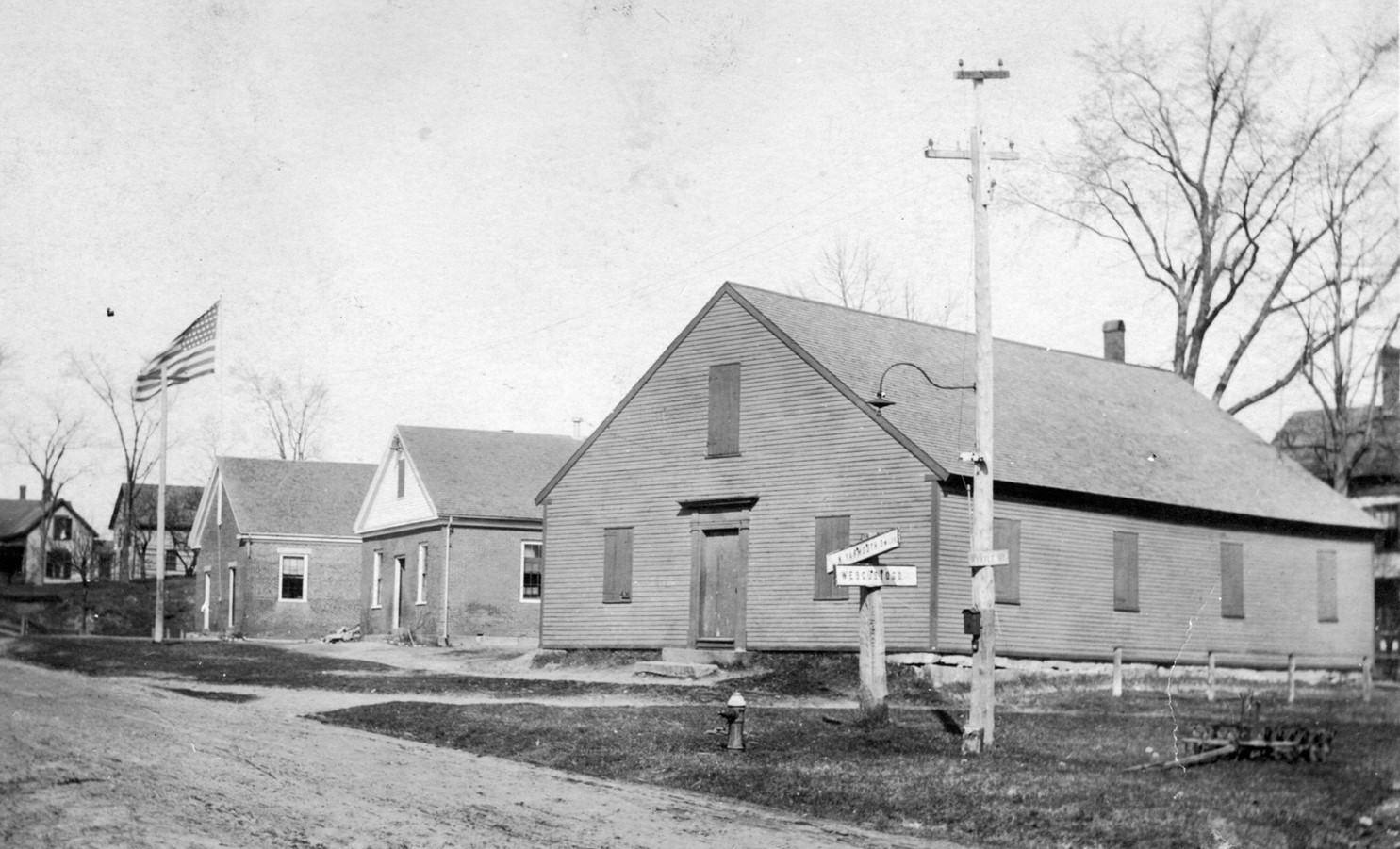
A series of special town meetings was called in the spring and summer of 1849, with some of the meetings attracting such a large crowd that the old Town House at the corner of West Main Street and Sligo Road (pictured above; no longer extant) could not possibly accommodate so many voters. So, the votes were moved onto the street outside, with voters for and against division lining up on opposite sides of the street. Rowe recounts that the first of these votes included 277 votes in favor of division and 177 opposed.
Of this era of debate over the future of the town, Rowe writes:
Excitement ran high in town. Discussions resulting at times in blows took place on the street corners. The traders in the village were boycotted by the aggrieved inhabitants of the northern part of the town who declared that they would neither sell to nor buy from those who favored division. “Northers” and “Southers” as the two factions were dubbed enacted on a small stage the drama that thirteen years later shook the nation, and the right of secession was bitterly discussed, pro and con. (Ancient North Yarmouth, p 245)
Eventually, the local votes were decided in favor of division and the Maine state legislature passed the act incorporating the town of Yarmouth on August 2, 1849. It was approved and signed by Governor John Dana on August 8 and took effect on August 20. The new charter laid out the terms for “closing the books” on the old town, dividing taxes, and adjusting school funds, among other financial items. Any landowner whose land was on the new dividing line could choose which town they wished to join. Rowe reports that it took another nine years before all the issues and questions related to the division of the towns were finally settled.
In August 1949, the Village Improvement Society organized a centennial celebration that featured a parade along Main Street (with prizes for the best costumes and floats), a history pageant at North Yarmouth Academy, a village fair and church service at the Old Meeting House, an exhibit of historical artifacts at Merrill Memorial Library, and an old fashioned dance at the Masonic Hall (now the location of Gather), among many other events. It was a three-day celebration that also coincided with the VIS’s annual Old Home Days.
Click here to learn more about the events planned for this year’s 175th celebration!